Do Massages Really “Change” Your Muscles?
Or Are We Being Sold a Very Convincing Story?
You might have seen posts like the one below on social media.
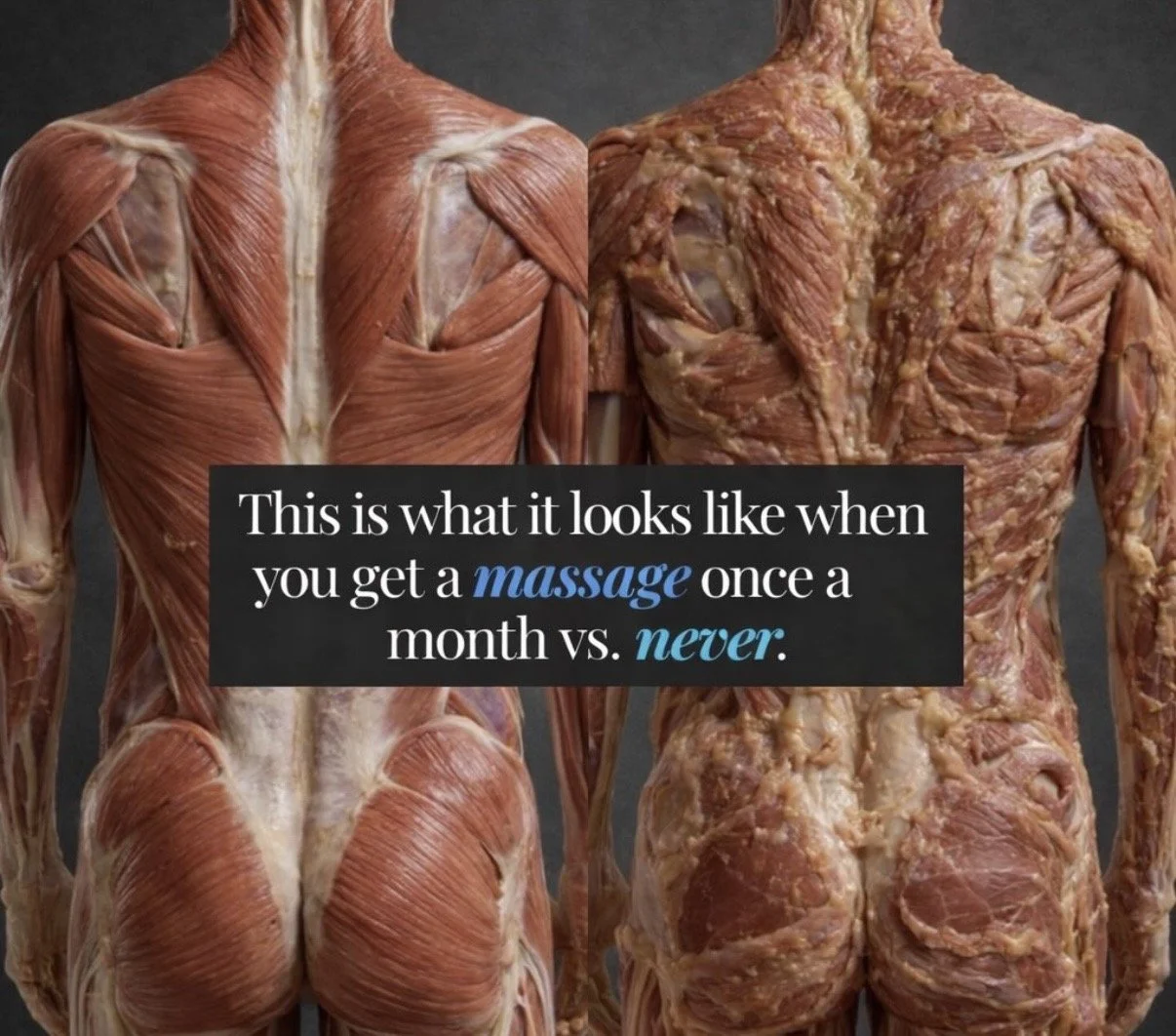
Two images of the human body side by side.
One labelled “gets a massage once a month”.
The other “never gets a massage”.
The message is clear:
👉 No massage = your tissues turn into a mess.
It looks dramatic.
It feels convincing.
And….it’s load of nonsense.
Let’s Start With the Big Claim
The post suggests that massage physically changes your muscles and fascia, keeping them “healthy”, elastic, and well-organised — and that without it, your tissues stiffen, clump together, and break down.
That sounds scary.
But here’s the reality:
There is no good scientific evidence that massage causes long-term structural change in muscles or fascia.
Not because massage is “bad”.
But because it simply doesn’t apply anywhere near enough force to do what it claims.
The Force Problem (This Is the Crux)
Fascia is strong. Very strong.
Research looking at the mechanical properties of fascia shows that to permanently deform it, you’d need forces many times greater than a human can produce with their hands.
To put that in perspective:
Even very deep massage generates maybe 100–300 newtons of force
Estimates for changing fascia are orders of magnitude higher — think hundreds of kilos of force
A useful analogy?
👉 A massage trying to change fascia is like a five-year-old trying to lift a truck. They can try their very best… but the truck isn’t moving.
“But I Feel Looser After a Massage!”
Absolutely — and that part is real.
Massage can:
Reduce pain temporarily
Calm the nervous system
Make you feel more relaxed and less guarded
Improve short-term comfort
What it’s doing is changing how your nervous system perceives tension, not physically remodelling tissue.
That “looser” feeling is more like turning down the volume knob — not rebuilding the speaker.
What About “Knots”?
Ah yes. Knots.
Despite how commonly the term is used, we don’t actually have good evidence that knots are literal lumps of muscle or fascia that need “breaking down”.
What people feel as knots is more likely:
Local sensitivity
Increased muscle tone
Protective tension
A nervous system that’s on high alert
Massage can calm that temporarily.
But it doesn’t remove a physical blockage or clean out tissue or toxin “buildup”.
There’s nothing stuck in there.
So Why Do Athletes Get Massages All the Time?
Good question.
Elite athletes use massage because:
If something gives them a 0.1% edge, it’s worth it
They have time, money, and support staff
It feels good and helps them relax between heavy training loads
That doesn’t mean it’s essential — or even beneficial — for most people.
What works for a full-time athlete with a recovery team doesn’t automatically make sense for someone juggling work, stress, sleep, and family life.
So… Is Massage a Scam?
No — but it is often oversold.
Massage can be:
A useful short‑term symptom modifier
A relaxation tool
Part of a broader recovery routine
It is not:
A way to change tissue quality long‑term
A substitute for movement or strength
A necessary monthly maintenance tool for healthy bodies
The Real Long-Term Game
If your goal is:
Fewer injuries
Better movement
More resilient muscles
Long-term pain reduction
Then the heavy hitters are:
Progressive strength training
Regular movement
Load management
Nutrition
Sleep
Stress management
Massage can be a nice extra.
It is not a maintenance requirement for your tissues.
Final Thought
Posts like this do very well on social media because they’re simple, dramatic, and slightly alarming.
And yes — lots of people buy into them.
But popularity doesn’t equal truth.
You don’t need monthly massages to stop your body “falling apart”.
Your muscles aren’t silently deteriorating.
And your fascia doesn’t need rescuing.
Choose movement over myths.
Education over fear.
And spend your time — and money — where it actually makes a difference.
Because movement — not maintenance — is what keeps us resilient.
